What is an AI visibility audit?
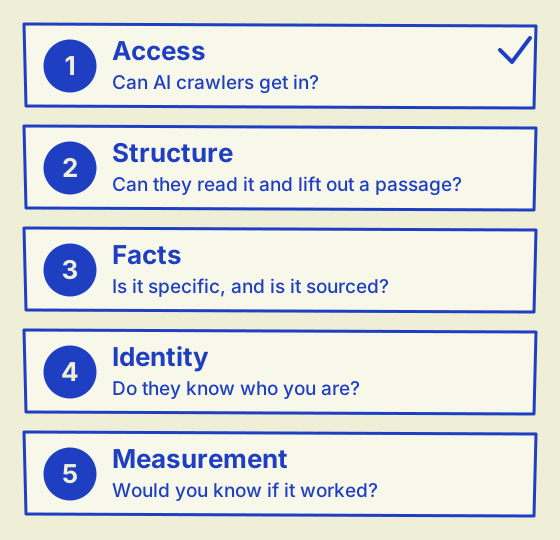
An AI visibility audit is a check of how easily AI assistants such as ChatGPT, Claude, Perplexity and Google's AI Overviews can find a website, read it, trust it and quote it. It looks at five things: whether their crawlers are let in, whether the pages can be read and quoted, whether the facts are specific and sourced, whether it is clear who is behind the site, and whether anyone is measuring the results. What you get at the end is a list of what is stopping the site from being cited, in the order worth fixing.
Key takeaways
- An AI visibility audit checks whether AI assistants such as ChatGPT, Claude, Perplexity and Google's AI Overviews can find, read, trust and quote a website.
- It covers five areas: crawler access, content structure, facts and sources, identity, and measurement.
- Access comes first: a site that blocks AI search crawlers, in robots.txt or at the firewall, cannot be cited however good its content.
- A useful audit shows the evidence for every result, puts the fixes in order of impact, and says what it cannot measure.
- An audit checks the site; it does not tell you what assistants say about you today. For that, ask them.
Why would a website need an AI visibility audit?
A website needs one because the reasons a site is left out of AI answers are mostly invisible from the outside. The site looks fine in a browser. It may even rank well on Google. Meanwhile a firewall rule meant for scrapers is quietly turning away the crawler that ChatGPT uses to find sources, and nobody on the team has any reason to notice.
The stakes are higher than with a page of search results. An assistant's answer usually names a handful of sources, not ten blue links, so there is less room near the top. And the AI companies are clear about what happens when their crawlers are kept out: OpenAI's crawler documentation says a site that blocks OAI-SearchBot will not be shown in ChatGPT search answers.
What does an AI visibility audit check?
A complete AI visibility audit checks five layers, and the order matters: each one only counts if the one before it is in place.
1. Access: can AI crawlers get in?
Access is about whether the AI companies' crawlers can fetch your pages at all. Each company runs several, for different jobs. OpenAI has GPTBot for training, OAI-SearchBot for search and ChatGPT-User for pages a person asks about (OpenAI's list). Anthropic has ClaudeBot, Claude-SearchBot and Claude-User (Anthropic's explanation), and Perplexity has PerplexityBot and Perplexity-User (Perplexity's documentation).
That split gives you a real choice. You can keep the training crawlers out and still let the search crawlers in, which is what decides whether you are cited.
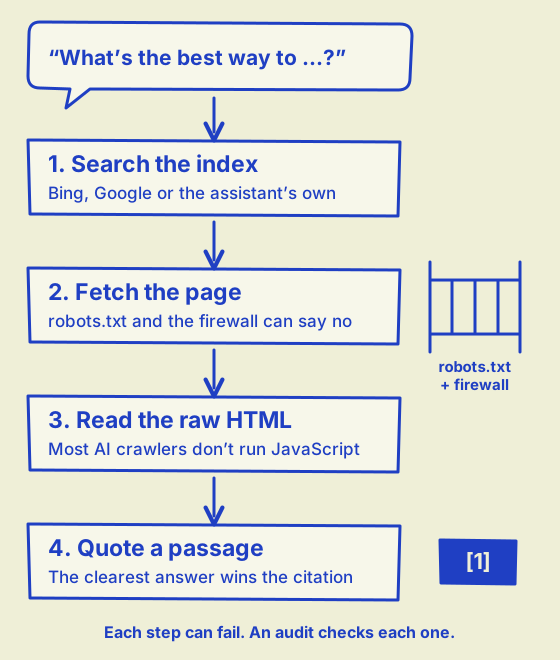
An audit reads your robots.txt the way the crawlers do (the rules are set out in RFC 9309) and tells you which ones are blocked.
It also has to test the firewall, because robots.txt is only half the story. On 1 July 2025 Cloudflare
changed its default to block AI crawlers unless site owners choose otherwise, and other bot-protection services challenge them too.
When we tested our own checker on 32 well-known websites in October 2026, we found that 6 of them (19%) turned our crawler away at the firewall, and 2 more (6%) served pages that were empty until JavaScript ran.
2. Structure: can they read the page and lift out a passage?
Structure is about whether a crawler that gets in can make sense of what it receives. Most AI crawlers read the HTML as it arrives and do not run JavaScript, so text that only appears after a script runs is not there for them. After that, the audit looks at headings, paragraphs and, above all, the opening lines.
Assistants quote passages rather than whole pages, so the first two sentences under a heading carry most of the weight. Take a page called "How long does probate take in Victoria?". If it opens with the usual timeframe in months, it can be quoted as it stands. If it opens with "Losing a loved one is never easy", the answer is three paragraphs down, and a competitor's page that gets to the point will probably be used instead.
3. Facts: is it specific, and is it sourced?
The facts layer looks for figures, definitions and examples, and for links to where claims came from. There is research behind this: in a study published at KDD 2024, a team of researchers found that adding citations, quotations and statistics to content raised its visibility in AI-generated answers by up to 40%. Freshness belongs here too. Pages should carry a visible date, and the dates in your sitemap should change only when the page does.
4. Identity: do AI systems know who you are?
Identity is about whether a model can connect your pages to one named organisation and trust it. The audit checks for Organization structured data, named authors with pages of their own, about and contact pages, links to your real profiles elsewhere, and whether your brand name is spelled the same way everywhere. Small inconsistencies, such as "Acme Co" in one place and "ACME Pty Ltd" in another, make that link weaker.
5. Measurement: would you know if it worked?
The last layer is the one most audits skip. It asks whether you could tell if any of this is working: analytics that separate visits from chatgpt.com, perplexity.ai and similar sites, your site verified in Google Search Console and Bing Webmaster Tools, and a fixed set of 10 to 20 questions you put to the assistants every month, noting who they cite. Google, for example, says traffic from its AI features is counted within ordinary web search figures in Search Console, so you have to look for it on purpose.
What should an AI visibility audit report include?
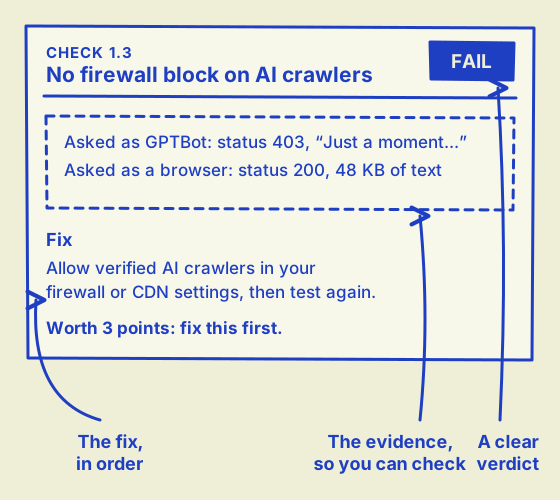
A good AI visibility audit report shows its working. Whoever runs it, by hand or with a tool, it should include:
- A clear verdict for each check: pass, partial or fail, not a vague grade.
- The evidence behind every verdict, such as the
robots.txtrule that blocks a crawler or the status code a firewall returned, so you can check it yourself. - Fixes in order of impact, each with an example of what good looks like.
- What was not checked, and why. Some things cannot be seen from outside a business, such as whether anyone reads the analytics.
- A way to re-test. The same rules should give the same result each time, so a second run after the fixes shows real change.
Be wary of audits that simply ask an AI model for its opinion of your site. Ask twice and you can get two different answers, which makes it impossible to tell whether your changes helped.
How is an AI visibility audit different from an SEO audit?
An SEO audit asks whether a page can rank in a list of links; an AI visibility audit asks whether a passage from the page can be quoted in an answer and credited to you. The two overlap, since assistants search an index before they answer, but an SEO audit rarely checks AI crawlers by name, firewall behaviour, or whether content survives without JavaScript. Our AI visibility audit page sets the differences out side by side.
Do you need an AI visibility audit?
You probably need one if customers research before they buy from you, if you publish advice or guides, or if competitors turn up in AI answers and you do not. It matters least for sites that do not want to be found, such as intranets, and for businesses whose customers all arrive by word of mouth.
There is a quick way to find out. Ask ChatGPT, Perplexity and Gemini three questions your customers ask, and look at the sources. If you are not among them, an audit tells you whether your site is the reason, or whether the gap is reputation, which takes longer to change.
What can an AI visibility audit not tell you?
An audit checks your site. It does not tell you what assistants are saying about you today, how well known your brand is, or how many other sites link to you, and those matter too. Nor can it promise citations: nobody outside the AI companies knows exactly how sources are chosen, and the methods change as models are updated. What it can do is remove the problems you control, which are often the ones keeping you out.
How do you get an AI visibility audit?
There are three ways, from cheapest to most expensive:
- Do it yourself. Work through the five layers by hand. Our step-by-step guide has every check and a checklist to download; allow an afternoon for a small site.
- Use a tool. Ours reads your robots.txt, your sitemap and up to 20 pages, and runs 40 checks across the five layers in about a minute. The score and six checks are free, and the full report with every fix costs US$9.
- Hire a consultant or agency. Worth it when you want someone to make the changes as well as find them, or when brand reputation is the bigger problem.
Whichever you choose, start with access. It is the quickest layer to fix, and nothing else counts until it is right.